
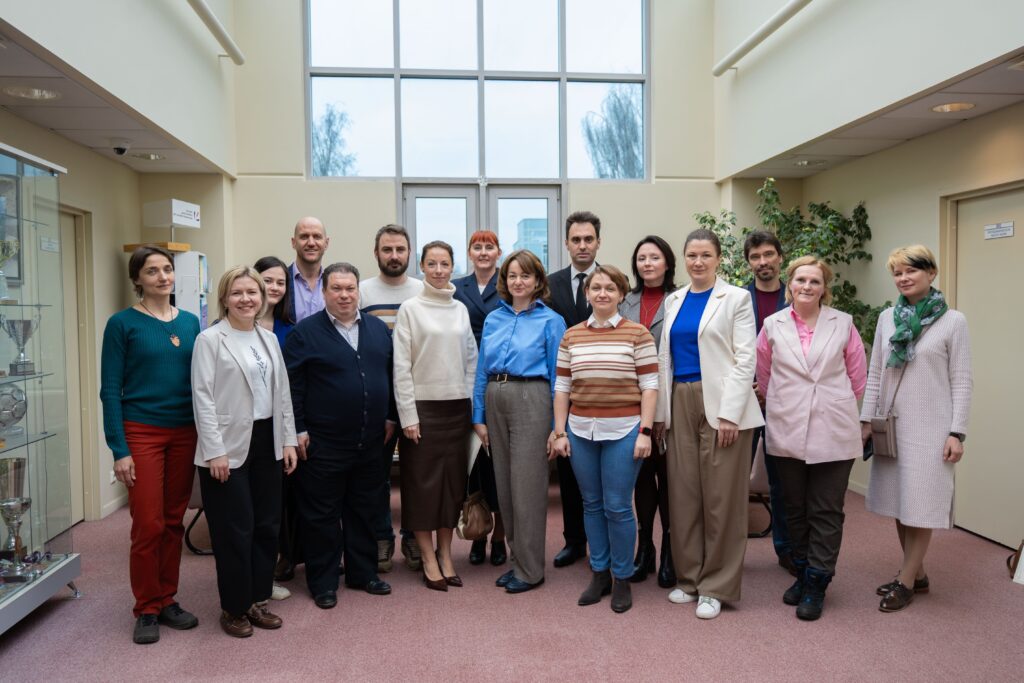
On April 9, Moscow State University (MSU) Business School and the Faculty of Biotechnology co-hosted a roundtable discussion titled “University and Business: Research-Intensive Projects, Technology Entrepreneurship, and Joint Educational Products.” The event brought together a strong lineup of experts from leading universities, research centers, and industry.
Participants explored how to build more effective partnerships between academia and business, to fast-track the adoption of scientific breakthroughs, and train professionals capable of making decisions in a rapidly evolving technological landscape.
From Skills to Shared Thinking
Participants noted that the convergence of science and industry is not new. Yet, with technology moving so fast and uncertainty on the rise, the old rules no longer apply. The core challenge boils down to a fundamental mismatch: universities are traditionally oriented toward depth and the search for “correct” answers, while business prioritizes efficiency and speed in decision-making.
Experts emphasised that academia-business collaboration should go beyond knowledge transfer and move towards cultivating new ways of thinking. At a time when educational programmes risk becoming outdated within just a couple of years, the most successful universities are those that immerse students in real business environments.
Sergey Kolesnikov, head of the AI and augmented reality (AR) technology programme at Neimark University and a graduate of MSU Business School, noted:
“University-industry partnerships are not merely cooperation – they represent a new architecture of trust and co-creation. However, a major barrier is the disparity in language and mindset: business speaks in terms of results and speed, whereas academia focuses on meaning and depth. Closing the language gap allows us to quickly pivot universities from ‘diploma mills’ into hubs for co-creating skills and solutions – such as corporate-linked projects, joint programmes, and R&D initiatives.”
Practice as the Foundation: Honest Feedback and Project-Based Learning
Participants cited project- and product-based courses featuring real industry clients as one of the most impactful formats.
Top-tier leading business schools have found that learning becomes truly transformative when students stop focusing on grades and immerse themselves in real-world business challenges.
An essential element of this model is the involvement of company representatives in project evaluations. Direct, often rigorous, industry feedback acts as a necessary reality check equipping students for both the professional and psychological demands of the field.
Ivan Matveev, First Deputy CEO of Ingosstrakh, stressed the role of technology in this process:
“By aligning curricula with corporate strategy and focusing on concrete challenges, universities and businesses can foster collaboration that delivers tangible, measurable outcomes. Entrepreneurial thinking is built through practice and accountability, which are key to bringing projects to fruition. Although the case method has long been effective, it is now bolstered by AI’s ability to analyze massive datasets, simulate complex scenarios and identify optimal solutions. Integrating AI with case-based learning produces superior outcomes, truly narrowing the chasm between theoretical knowledge and business practice.”
Intellectual Property and Interdisciplinarity
A central theme of the roundtable was the disconnect between “scientists” and “practitioners”. In fact, the success of joint projects between MSU’s Business School and the Faculty of Biotechnology has proven that designing market-ready products requires a shared, common value system.
To foster this, experts advised moving beyond treating intellectual property (IP) as a legal hurdle, advocating instead for proactive management and early ownership agreements. They also called for specialized IP education for future entrepreneurs.
Alexandra Rogacheva, Deputy Director of the Skoltech Center for Photonic Science and Engineering, summarised:
“I would like to thank the MSU Business School for organising this timely discussion and for the opportunity to participate as an expert. It is clear that stronger university-business ties are no longer just desirable – they are essential for bringing high-tech innovations to the market. The future lies in embedded collaboration: joint laboratories, project-based learning with real-world challenges, and involving industry directly in curriculum design.”
Looking Ahead: Ecosystems and Mentorship
Concluding with a vision for the future, participants called for a ‘University 3+’ model – uniting university, business, and government – alongside the formation of professional educator networks in tech entrepreneurship and the active use of AI. Above all, they underscored that people remain central, relying on mentorship to ensure continuity of knowledge.
Irina Berezovskaya, Head of Business Practice and Career Development at the MSU Business School, summed up the discussion:
“Academia and business are no longer separate entities; they are a unified, integrated force for value creation. Our roundtable convened a unique group of experts to tackle a crucial question: how can we accelerate the journey from scientific idea to market-ready product. Our key takeaway? Success depends not only on technological capacity, but also on the ability to reach clear agreements – on goals, metrics, and rights – from day one. The future belongs to flexible education products and on-campus entrepreneurship. We thank our partners for their openness and commitment to building this collaborative future, starting now.”
The Lomonosov Moscow State University (MSU) Business School expresses its deep gratitude to all invited experts:
Ivan Matveev – First Deputy CEO, Ingosstrakh Insurance Company.
Anna Bragina – Market Analytics and Marketing Research Manager, SPLAT Global.
Sergey Kolesnikov – Head of the AI and AR Educational Programme, Neimark University.
Denis Nalobin – Deputy Dean, Faculty of Biotechnology, MSU.
Alexandra Rogacheva – Deputy Director for Translational Research at the Skoltech Center for Photonic Science and Engineering; Associate Professor. Anna Getmanskaya – Head of Outreach and Partnerships, SKOLKOVO Business Bachelor’s; Head of the «Career Navigator for Teens» programme.
Anastasia Druzhinina – Academic Supervisor of Project Disciplines, ITMO University.
Irina Stolyar – Strategic Consultant on Managerial Thinking and Decision-Making; Business Trainer; PCC ICF; Federal Expert for the Agency for Strategic Initiatives (ASI).


